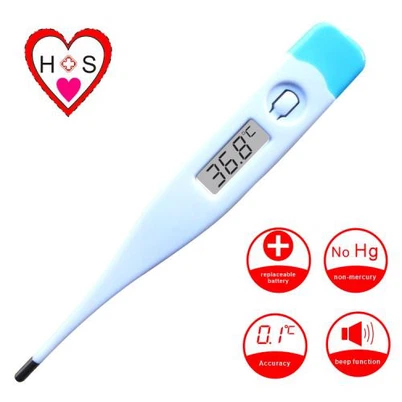
Hi ha alguna diferència entre un termòmetre per a nadons i un termòmetre per a adults?
Deixa un missatge
Els nadons són febles i tenen poca immunitat. És inevitable que tinguin refredat i febre durant el procés de creixement i desenvolupament. Cada família ha de preparar un termòmetre per a nadons, però molts adults i nadons compartiran un termòmetre, doncs, quina diferència hi ha entre un termòmetre per a nadons i un termòmetre per a adults?
Hi ha alguna diferència entre un termòmetre per a nadons i un termòmetre per a adults?
Els termòmetres per a adults no són especialment diferents dels termòmetres per a nadons. Els termòmetres per a nadons solen mesurar la temperatura rectal i el capçal de mesura de la temperatura hauria de ser més curt i gruixut. Els nadons tenen una temperatura corporal més alta que els adults. Temperatura anal: (el valor normal és de 37,5 graus) Aquest és el mètode més precís, però cal tenir en compte que la capacitat de contracció de la màquina d'esfínter anal del nounat és feble i és fàcil sentir-se restrenyiment quan s'estimula, així que cal parar més atenció.
Temperatura oral: (el valor normal és de 37 graus) Aquest mètode es pot utilitzar per a nadons més grans, però per motius de seguretat, els pares han de tenir cura d'ells per evitar que el nadó mossegui el termòmetre i ocasioni perill. Temperatura axil·lar: (valor normal 36,5 graus) Si no es fixa correctament, la temperatura mesurada sovint perd la seva precisió, de manera que la precisió és deficient. Heu afegit 0.5? Si l'heu afegit, és normal. Si no l'heu afegit, tindreu una mica de febre baixa-. Podeu donar més aigua al vostre nadó per beure.
The baby thermometer can be used by adults. There are many types of baby thermometers, such as infrared thermometers, ear thermometers, and smart thermometers. These are designed for infants and young children to quickly measure the baby's body temperature because traditional mercury thermometers are fragile and time-consuming, and the movement of infants and young children will affect the final body temperature result. Therefore, there is no temperature error because of adults or infants.
Els adults utilitzen els termòmetres per a nadons de la mateixa manera. Per exemple, els termòmetres electrònics prenen la temperatura a la boca, l'aixella i l'anus. Com que la precisió dels termòmetres electrònics no és suficient, cal mesurar-los diverses vegades per obtenir el valor intermedi. El termòmetre frontal no necessita tocar la pell i pot conèixer la temperatura corporal en un segon, però trigarà una estona a mesurar-se si acabes de tornar de l'exterior. Quan utilitzeu el termòmetre de l'oïda, presteu atenció a si el cerumen s'acumula massa, cosa que afecta l'ús normal. El mateix, excepte que el termòmetre de mercuri és incòmode per als nens petits i pot ser perillós si es trenca accidentalment. En general, es recomana als nens utilitzar un termòmetre d'orella.
Quina és la temperatura corporal normal d'un nadó?
La temperatura corporal es mesura generalment en tres parts, és a dir, la cavitat oral, l'aixella i l'anus. La temperatura corporal normal està entre 36,5 graus i 37,5 graus a l'anus; entre 36,2 graus i 37,3 graus a la cavitat bucal;. Després de superar la mesura, quan supera el rang normal en més de 0,5 graus , s'anomena febre.
It is often said that babies under one year of age have a normal body temperature below 37.5 degree . The reason is that the center that controls thermoregulation in the baby's brain has not yet matured, that is, the ability to control body temperature is not strong enough so the baby's body temperature will be affected by the ambient temperature. In hot weather or with too much wrapping, the body temperature will rise slightly, but it should not exceed 37.5 degree . In cold weather or air-conditioned rooms with low temperatures, the body temperature can drop to 36 degree or lower.
In the hot summer, the temperature is very high, and the baby's ability to regulate its own body temperature is poor. When the mother holds the baby, the heat is not easy to dissipate, which increases the body temperature. However, this kind of fever usually does not last for a long time. Put the child in a cool place, fan it a little, give the child some cool fruit juice, or give the child a warm bath. After a few hours, the body temperature will drop to normal. In winter, if the indoor temperature is too high and the baby is wrapped too much, the baby's body temperature will also rise.
A baby's normal body temperature is between 36 degree and 37.5 degree and is generally based on-ear and rectal temperature. The temperature in the mouth, armpit, anus, and ear is generally measured. The normal body temperature range: is between 36.2 degree and 37.3 degree in the oral cavity; between 35.9 degree and 37.2 degree in the armpit; between 36.5 degree and 37.5 degree in the anus and ear.
The most convenient way to measure the baby's temperature at home is to measure the "armpit temperature". Under normal circumstances, the normal value of the baby's armpit temperature is 36 degree 37 degree , but if it is slightly higher than this value, it is not necessarily a fever. A baby's body temperature higher than 37 degree is not necessarily a fever! The baby's body temperature is affected by many factors. To get an accurate body temperature value, it should be measured after half an hour of feeding the baby and in a quiet state. If the baby continues to cry, has just finished feeding, or has just woken up wrapped in a quilt, the temperature measured in these cases may be slightly higher than 37 degree . Whether or not your baby's armpits are wet can also affect the measured body temperature. If your baby's armpits are wet, they need to be dried before measuring.